
CS Insights: Q3 Earnings Calls Demonstrate Peak Interest in AI as Tariff Intrigue Fades

December 8, 2025
What a difference a few quarters make.
Earlier this year, tariffs dominated news headlines and were one of the most important issues facing public company executives. Flash forward two quarters and concerns about the economy and tariffs have drastically dissipated.
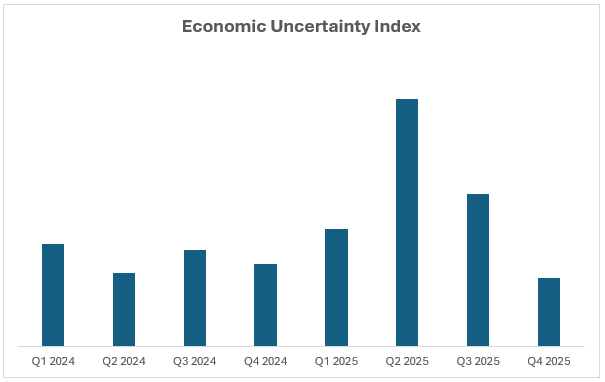
Collected’s “Uncertainty Index” – the number of conference calls referencing a variety of phrases mentioning an uncertain economic environment – substantially increased in the second quarter of 2025 as analysts pummeled executives for clarity on tariffs. However, as the year progressed, the concerns over the economy, along with questions about tariffs and inflation, abated.
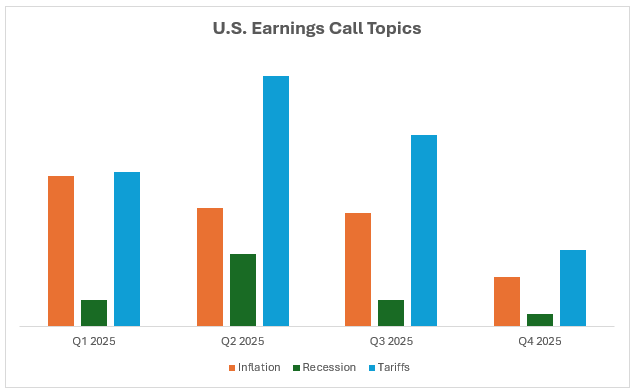
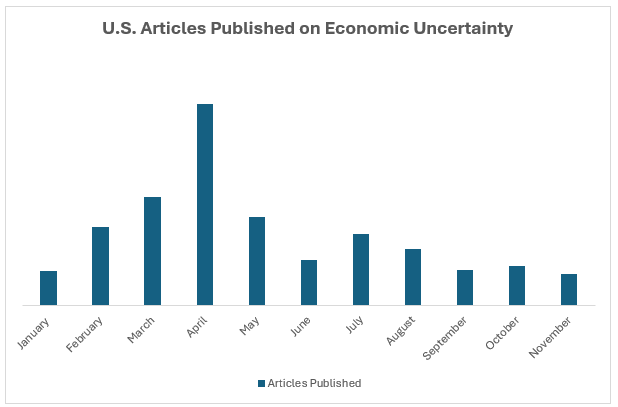
This trend is consistent with how the media has covered the same topics. Over the course of 2025, we saw a substantial increase in coverage referencing economic uncertainty, the state of the American consumer and tariffs in March and April following President Trump’s “Liberation Day.” This spike was short lived, with the intensity of coverage decreasing by the fall.
This is not surprising when you zoom out.
Across the past four quarters, management commentary and the overall tone on U.S. earnings calls has been driven by a handful of prominent macro- and policy-level topics, including tariffs, the implementation of AI, the “Big Beautiful Bill” and the government shutdown. These tend to be cyclical, reinforced by how the media hyper focuses on bigger issues.
Digging Deeper on Tariffs
The focus on, and pessimism about, tariffs has eased throughout 2025, as management teams have better articulated guidance impact and mitigation plans.
Early in 2025, companies struggled to quantify tariff impacts due to rapidly changing policies, but by the third quarter, many were able to provide precise estimates.
For example: in March, McCormick’s CFO described tariffs as a “fluid” situation, with plans to offset costs related to U.S. import tariffs with savings and targeted price adjustments. They were careful to note that, “Due to continued uncertainty on this topic, our outlook does not include any additional impacts from tariffs that could potentially be implemented this year. As things evolve, we will provide updates on our outlook within our typical reporting cadence.” Three months later in June, McCormick provided a specific tariff exposure and mitigation plan, which it proceeded to update in October. Many other companies have followed the same playbook.
We’ve observed that the strategies detailed by companies discussing mitigation strategies have generally fallen into one of five buckets:
- Pricing adjustments
- Sourcing diversification
- Supply chain optimization
- Domestic production expansion
- Supplier concessions
By leveraging a variety of these tactics, companies have been able to more specifically articulate go-forward strategies for managing tariffs, providing the detail analysts were looking for earlier in the year.
Another contributing factor to the decline in mentions is that not as many companies have been directly impacted as once feared. An October research report published by Deutsche Bank estimated that companies directly hit by tariffs have accounted for a very small portion (~12%) of S&P 500 Earnings. This reinforces that interest has waned as analysts and investors have gained more clarity that the potential earnings hit is smaller than anticipated.
AI Interest Reaches All-Time High in Q3
Interest in AI reached an all-time high in the third quarter of 2025, as skeptical analysts and investors began to question the sustainability of eye-popping investment figures and how companies are generating returns.

The number of calls mentioning AI related topics has dipped thus far in the fourth quarter, with other topics, like the government shutdown, eating into the limited time analysts have for questions. Given the overall trendline and the amount of capital deployed into AI investments, we would be shocked if Q3 remains the all-time peak.
Our analysis of AI topics reveals that management commentary repeatedly hits a few areas more than others.
Operational Efficiency and Cost Management
Many companies are leveraging AI tools for internal productivity gains and cost optimization. Companies widely disclose deploying tools like Copilot across their organizations to improve productivity in areas like finance, HR and supply chain management.
Monday.com noted that "every division is doing better with using AI" and development work that "used to do things that took months. Now, they're being done in days and weeks.” IBM reported 220 basis points of segment profit margin expansion in 2025 through its “hybrid model of people plus software.” It stated that it expected $4.5 billion of run-rate savings by the end of 2025, with the opportunity for more in the years to come. And Aterian noted using AI instead of hiring new people, indicating that “Our focus for AI continues to be on creating operating leverage and scale for future growth rather than immediate headcount reductions.”
Revenue Generation and Monetization
Another frequent AI topic centers on revenue categorization and growth as companies try to detail how they’re monetizing AI.
Reporting methods vary, with some companies creating distinct revenue segments for AI products or disclosing specific performance metrics like Annual Recurring Revenue (ARR) for AI sales. In addition, a number of companies are reclassifying revenue streams as they embed AI into existing offerings. This strategic repositioning allows companies to showcase AI's contribution while managing investor expectations about revenue shifts between segments.
The most interesting example of this comes from Thomson Reuters Corp, a traditional media company. Thomson Reuters reports the revenue it generates from licensing deals with GenAI platforms as a specific line item within its news segment: “transactional generative AI content licensing revenue.”
.png)

